CAN AI REALLY OUTPERFORM HUMAN TRADERS IN THE VOLATILE COMMODITIES MARKET?
Explore the evolving role of artificial intelligence in futures trading, where speed, data depth, and predictive modeling challenge traditional human intuition and experience. This post will dissect the strengths and limitations of AI-driven systems versus seasoned traders, especially in volatile sectors like cocoa, sugar, and energy.
FUTURES TRADING
C. Michelle
11/4/20253 min read
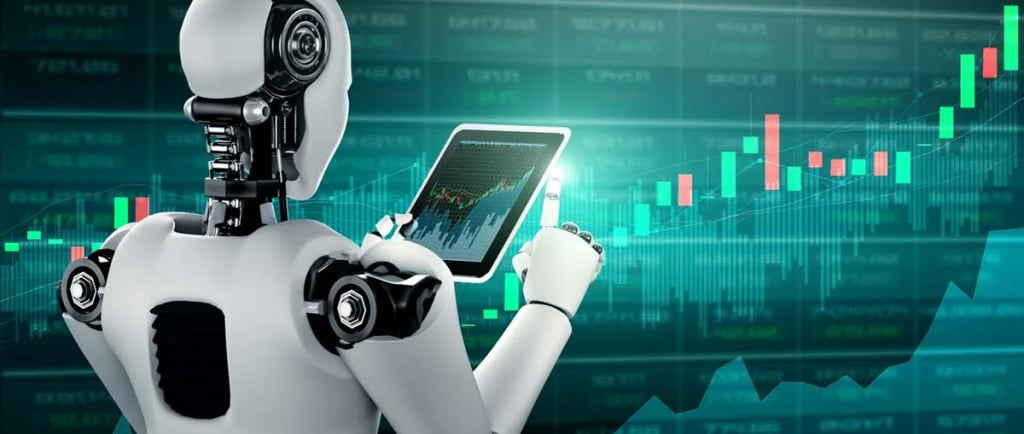
The world of commodities trading is no stranger to volatility. From sudden oil supply shocks to unpredictable crop yields, price movements often depend on a web of global factors. For decades, success in this field relied on human intuition and experience. But now, artificial intelligence (AI) is changing the game.
With the ability to analyze millions of data points in real time, AI trading algorithms are redefining how traders forecast prices, assess risk, and execute trades. The big question is: can AI truly outperform human traders in the commodities market?
The Case for AI: Speed, Scale, and Objectivity
AI doesn’t sleep, second-guess itself, or fall victim to emotions, three major advantages in markets that move at lightning speed.
Modern AI systems can analyze:
Real-time pricing data from global exchanges
Weather forecasts affecting crops or energy demand
Satellite imagery showing crop yields or mining activity
Social media and news sentiment related to commodity trends
Machine learning models then identify patterns and correlations, updating their predictions in real time. For instance, an AI system can detect that a heatwave in Argentina is likely to cut soybean yields and immediately adjust trading positions before human analysts even read the news.
This combination of speed and predictive power allows AI-driven trading systems to capitalize on micro-opportunities that human traders might miss. Similarly in procurement, AI can optimize supplier selection, model trade margins, and even simulate geopolitical risk scenarios. Autonomous agents are now capable of negotiating contracts, verifying documentation, and flagging anomalies all without human intervention.
The Human Edge: Why Instinct and Intuition Still Matter
The "Unknown Unknowns": AI models are trained on historical data. They struggle with true "Black Swan" events such as a sudden war, a pandemic, or a major political collapse that have no precedent. A human can make a reasoned, albeit risky, judgment call.
Geopolitical Nuance: Understanding the subtle implications of a diplomatic statement or the stability of a regime in a resource rich country requires a deep, contextual understanding of politics and history something AI lacks.
Supply Chain Synthesis: While AI can track a supply chain, a human expert can synthesize disparate information a factory fire, a new environmental regulation, a shift in consumer preference into a coherent narrative about long-term price direction.
Strategic Oversight and Creativity: Humans define the trading strategy and the "why." They ask the big questions and can creatively adapt to a changing world, while AI optimizes the "how."
While AI can process data faster, it often lacks context. Human traders bring judgment, creativity, and strategic reasoning qualities that remain difficult for algorithms to replicate.
Case Studies: Cocoa, Sugar, and Energy Markets
Cocoa: AI models can forecast crop yields using rainfall and soil data, but they often miss local disruptions like labor strikes or port delays.
Sugar: Pricing algorithms may optimize trade margins, yet human traders often secure better terms through direct negotiation and timing.
Energy: AI excels in predictive modeling for demand and futures pricing, but geopolitical shocks (e.g., sanctions, OPEC decisions) require human interpretation.
Real-World Examples
Cargill and BP use AI tools to forecast agricultural and energy price movements.
Hedge funds like AHL and Renaissance Technologies employ AI to optimize commodity trading strategies.
Commodity exchanges now deploy AI-based surveillance to detect price manipulation and unusual trading behavior.
Across the board, AI is proving to be not just a tool but a competitive advantage especially when paired with human expertise. Furthermore, it is determined that where AI excels is with short-term arbitrage, statistical arbitrage, and managing highly diversified portfolios across numerous commodities to capture small, consistent gains. And where humans dominate is with long-term, macro-themed trades (e.g., "the energy transition will drive demand for copper and lithium for a decade"). Navigating periods of extreme market stress and regime change.
Risks of Overreliance on AI
Black-box models can be opaque, making it hard to audit decisions.
Overfitting to historical data may lead to poor performance in novel scenarios.
Ethical and regulatory concerns arise when autonomous systems execute trades without human oversight.
The Future is a Partnership: The Centaur Model
The most successful hedge funds in the world aren't purely AI or purely human. They operate on a "Centaur" model named after the half-human, half-horse mythical creature.
The AI is the legs: It provides immense speed, power, and data-crunching capability.
The Human is the brain: It provides strategic direction, creative insight, and ethical oversight.
In this model, AI handles the quantitative heavy lifting and identifies opportunities, while human traders provide the final strategic veto or approval, especially for large, directional bets.
Conclusion: AI vs. Humans — Or AI with Humans?
So, can AI outperform human traders?
In terms of speed, scalability, and pattern recognition — yes.
In areas requiring context, intuition, and adaptability — not yet.
The future of commodity markets lies in collaboration. AI will continue to handle massive data processing and predictive modeling, while humans will focus on creativity, interpretation, and strategic decision-making.
Ultimately, the most successful traders won’t be those who compete with AI but those who learn to trade alongside it.
TRADING
Expertise in commodities trading, advisory, and procurement management services.
CONTACT
Churchill Executive Towers, Office 900 Business Bay, Dubai, UAE
801 Brickell Ave Ste 811 Miami, FL 33131
Dubai - 971 55 117 7276
Miami - 305 461 0016 info@stonekingdomcap.com